Share This Article
OnlyFans free pages look like a no-strings arrangement, but the real cost hides in how often the creator sends pay-per-view messages. PPV density is the ratio of paid unlock opportunities to freely visible content, and reading it correctly is the difference between a quiet page and a monthly bill you did not plan for.
The title’s promise is simple: external ranking cards carry signals that predict that pressure before you follow anything. Those cards rarely publish literal prices, but they do encode posting rhythm, locked content ratios, and activity streaks.

What PPV Density Means for Subscriber Budgets
A free page sets its base subscription to $0 and earns through PPV messages and tips instead. Density measures how aggressively that earning happens: a page that publishes twenty free posts a month and two unlocks sits near the low end, while one that publishes five free posts and thirty unlocks sits at the high end.
There is no checkout moment to force a pause and no renewal email to act as a speed bump. Spending happens one unlock at a time, each one small enough to feel trivial in isolation.

PPV messages unlock content priced up to $50, and paid chat commonly runs $3-$5 per message. A page sending two or three paid prompts a day can therefore generate more monthly spend than a $9.99 paid subscription that bills once and stays quiet.
- Low density: occasional unlocks in the $3-$5 band, usually tied to specific requests or one-off sets.
- Moderate density: weekly unlocks that accumulate to roughly $10-$15 per month for an average follower.
- High density: daily unlock opportunities that can reach $50 or more monthly if you accept most of them.
Density gives you the frequency; the platform’s price ceiling gives you the worst case. Multiply the two and you have a number worth comparing against what you actually want to spend.
Tip: set a prepaid card or wallet balance for free-page follows. When the balance hits zero, the decision to top up becomes deliberate instead of automatic.
Ranking Card Visual Cues for Message Frequency
A card has to compress weeks of activity into a small visual block, and the compressions it chooses reveal how the page operates.
A high count relative to account age suggests frequent posting, but it says nothing about whether that media is free, locked, or a mix. Pair the count with the locked content ratio indicator to see the split.
- Total media count relative to account age, which separates steady publishers from burst posters.
- Locked content ratio indicators, which show how much of the visible catalogue sits behind an unlock.
- Tip menu visibility flags, which mark pages that surface paid requests prominently.
- Promotional message frequency tags, which hint at how often followers receive paid prompts.
- Creator activity status timestamps, which confirm whether the page is currently active or dormant.
One creator posts daily and never charges; another posts weekly and charges for most of it.

Creators who enable two-step authentication and keep their settings tight tend to run their pages more deliberately, which usually shows up as scheduled messaging rather than random blasts.
Quantitative Versus Qualitative PPV Indicators
Interpretive signals require context, but they explain the outliers that raw numbers cannot. The table below separates the two groups so you can weigh each one appropriately.
| Signal Type | Specific Indicator | Interpretation Method |
|---|---|---|
| Quantitative | Post frequency | Compare against account age to find the true publishing rate |
| Quantitative | Media count | Read alongside locked ratio, never alone |
| Quantitative | Visible PPV unlocks | Count how many entries show a lock symbol |
| Quantitative | Tip menu items | More listed items suggests more paid interaction paths |
| Qualitative | Engagement ratio | High followers with low interaction hints at passive audience |
| Qualitative | Category norms | Judge density against what the niche typically does |
| Qualitative | Activity streak length | Long unbroken streaks predict reliable future messaging |
| Qualitative | Dual-page presence | A free page paired with a paid page suggests clearer tiering |
Quantitative signals tell you what already happened. Neither group works without the other, and cards that present only counts tend to mislead newcomers most.
If you want a second reference point for these patterns, collections of best onlyfans stats can help you compare density figures across many pages at once rather than judging a single card in isolation.
Category Baselines: Expected PPV by Content Niche
Different content categories carry different implicit norms, so the same unlock frequency can read as aggressive in one niche and routine in another.
Fitness pages, for example, often publish a large free volume of workout content and reserve paid unlocks for extended routines or personalised plans. Aesthetic and lifestyle pages frequently run the opposite pattern, with fewer free posts and more paid prompts.
| Content Category | Typical PPV Density | Budget Planning Guidance |
|---|---|---|
| Fitness and coaching | Moderate, tied to program cycles | Expect peaks when a new program launches |
| Aesthetic and lifestyle | Moderate to high, steady | Assume a recurring weekly unlock habit |
| Interactive and chat-led | High, driven by conversation | Plan a per-message cap before following |
Category norms also explain price bands. Typical paid subscriptions cluster in the $4.99-$15 range, with averages around $5-$10, but free pages in chat-heavy niches earn more per follower through PPV than paid pages in quieter niches earn through renewals.
When a card shows unusually high density for its category, treat that as a deliberate positioning choice rather than an accident. The creator has decided to monetise attention directly, and the card is telling you so.
Temporal Patterns in PPV Campaign Deployment
PPV messages do not arrive evenly. Creators time them around moments when followers are most likely to spend, and ranking cards that track posting history expose those rhythms.
Holiday and event themes bundle unlocks into a narrative that feels time-limited even when it is not.
- Weekend unlock pushes: concentrated Friday through Sunday, when browsing sessions are longest.
- Early-month targeting: heavier volume in the first week after pay cycles land.
- Event and holiday blasts: themed drops tied to calendar moments.
- New follower drip sequences: a scripted run of prompts across the first 48 hours after a follow.
A drip sequence front-loads paid prompts right after you follow, before you have formed any judgement about the page’s value.

Muting push alerts for the first two days is a reasonable countermeasure, and it costs nothing but a settings change.
Aggregated Signals Across Multi-Page Following
Each one may sit at moderate density on its own, but the totals add up faster than most people track.
Follower counts amplify the illusion. A page with a large audience feels established and therefore safe, even when its density is high. The two properties are unrelated, but the card layout often places them side by side.
- Follower count inflation: large audiences mask per-follower costs that remain unchanged.
- Notification volume: more pages means more prompts, which drives impulse unlocks.
- Budget fragmentation: small amounts spread across many pages never appear as one visible total.
A workable approach is to cap the number of free pages you follow at once, then review the actual spend after one month. If the total surprises you, density was higher than the individual cards suggested.

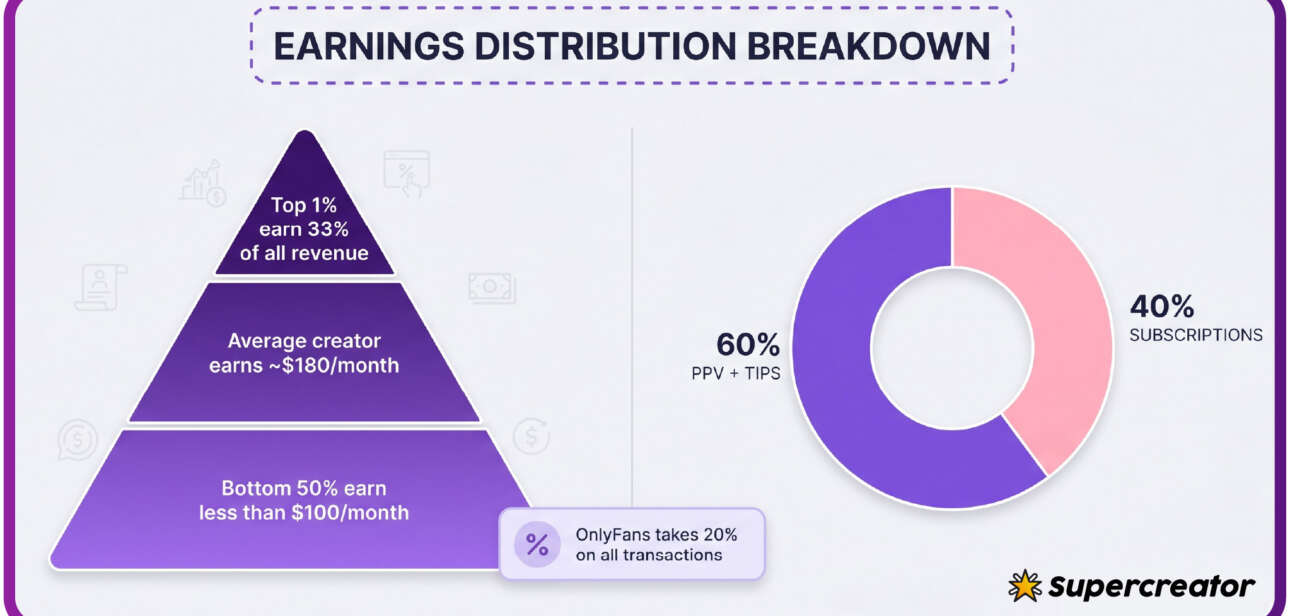
The platform takes a 20% fee on everything, and the creator keeps 80%. That split applies to unlocks just as it applies to subscriptions, which is why free pages have a strong incentive to keep PPV volume steady rather than occasional.
BestOnlyFans Ranking Methodology for PPV Transparency
Most ranking projects were built for paid-page comparison and treat a $0 subscription as an edge case. That produces cards where a free page’s unlock behaviour is invisible, and you only discover the pattern after following. BestOnlyFans structures density indicators specifically for free-page evaluation, separating them from the metrics used on paid pages.
The effect is that you can compare a free page’s expected monthly pressure against a paid page’s fixed renewal cost in the same view. If you’re concerned about impersonation accounts and lookalike pages, review guidance on phishing scams before trusting any external link, including ranking cards themselves.
Pre-Follow Evaluation Protocols Using Card Data
It takes a few minutes per page and saves the more tedious work of untangling a month of small charges afterwards.
- Cross-reference the PPV density score against historical price stability, since unstable pricing often precedes aggressive promo cycles.
- Compare the estimated monthly cost against a prepaid load amount you have already decided on.
- Verify posting recency to tell an active high-density account apart from a dormant one with a stale catalogue.
- Note whether the creator runs a dual-page structure, with a paid alternative that may suit you better than the free page.
Where a card shows a promotional first month, remember that promotional pricing may sit below $4.99 while base pricing never does. The $4.99 minimum applies to the standing rate, and a $3 first month is a temporary entry point rather than the real cost.

One more mechanic worth knowing: when a creator raises their price, auto-renew stops and existing access lasts until the paid period ends. On free pages there is no renewal to stop, which is exactly why density review has to happen before the follow rather than at a billing boundary.
Card data will not tell you whether a page is worth your money. It tells you what following is likely to cost, which is a narrower and more useful question.
FAQ
Do ranking cards show actual PPV prices or just frequency of paid messages?
Most cards show frequency and patterns rather than exact prices, because unlock prices vary per message and can change without notice. Use the card to estimate how often prompts arrive, then assume the platform ceiling of up to $50 per unlock for a worst-case figure.
Can I filter BestOnlyFans results specifically for low-PPV free pages?
Filtering options depend on the ranking project, but density-aware cards generally let you sort by messaging rhythm or locked ratio. Sorting by locked ratio ascending surfaces pages that keep most of their catalogue free.
How quickly do PPV density patterns change after I follow a free page?
Drip sequences can begin within hours of a follow, which is when new-follower prompts are most concentrated. Longer-term patterns usually stabilise after a few weeks, so a one-week sample can overstate the steady-state density.
What’s the difference between PPV density on free pages and tip frequency on paid pages?
Paid pages earn a predictable base from renewals and treat tips as optional extras. Free pages have no renewal income, so PPV and tips carry the whole revenue load, which is why unlock frequency tends to run higher there.